
Forest and Ecosystems
Peru shelters one of the greatest varieties of forests and ecosystems on Earth. In the Manu Biosphere, the Andes and the Amazon merge into an unbroken gradient of life — from cold grasslands to cloud forests and tropical jungles, each forming part of the planet’s living tapestry.
In a megadiverse country like Peru, around 80% of the planet’s ecosystems can be found within its borders, along with an immense variety of forests. In the Manu Biosphere, from the Andean highlands downward, we find a succession of ecosystems: the puna, dwarf forests, montane forests, cloud forests, and the high jungle. As we reach the Amazonian lowlands, a range of forest types emerge — such as the aguajales, dominated by Mauritia flexuosa palms; the high forests, free from flooding, with tall emergent trees; and the floodable forests, with shorter, resilient vegetation. Along riverbanks grow succession forests of cecropias, balsa trees, tessarias, and cane brava.
There are also oxbow lakes (cochas), palm swamps, savannas, and blackwater rivers. Many other forest types still lack scientific classification, though Indigenous communities distinguish them clearly in their own knowledge systems.
PÁRAMO ANDINO (3500–4000 m)
The Andean páramo is made up of treeless highlands crowning the mountain summits above the Andean and tropical forests. These areas are cold and humid, with abrupt weather changes and frequent fog. Rainfall is common, and strong winds sweep across the open terrain.
Cold, rainy days alternate with warm, clear ones, but nights are always cold. The vegetation consists mostly of grasses, mosses, lichens, shrubs, and chachacomo trees, along with orchids, bromeliads, and other microflora. The fauna varies depending on geography; in Manu, species such as the gray deer, spectacled bear, vizcacha, Andean fox, and wild guinea pigs are found, along with a great diversity of birds like mountain toucans, hummingbirds, caracaras, and raptors.
BOSQUE ENANO (2500–3500 m)
This “dwarf forest” is characterized by short vegetation rarely exceeding 10 meters in height, with abundant epiphytic and endemic plants. The trees are usually covered with mosses, lichens, and orchids, and their leaves are small and leathery. These forests capture moisture through their foliage, channeling water toward the soil and acting as vital sources of water during the dry season.
BOSQUE DE NUBES (1200–2500 m)
When warm air rises against the Andes, it cools and condenses, forming a permanent crown of mist that envelopes the steep slopes — the cloud forest. Here, evergreen trees are festooned with mosses, lichens, orchids, and ferns. It is home to the spectacled bear, the brilliant red cock-of-the-rock, and countless bird species. The cloud forest is one of the least studied yet most biologically diverse ecosystems on the planet. Nearly 50% of its plant species are endemic. The Manu Biosphere Reserve protects the largest untouched expanse of cloud forest in the world.
SELVA ALTA (500–1200 m)
The “high jungle” occupies the last eastern slopes of the Andes. Here, the terrain softens, and rivers converge on their way to the Amazon basin. In the 1970s, with the construction of the road to the Madre de Dios valley, colonization increased rapidly. Settlers from the Andes arrived seeking fortune through selective logging and agriculture, mainly coca cultivation. Over time, native forests were replaced by farmland, and indigenous populations declined due to introduced diseases and displacement. Today, only a few native communities remain, preserving fragments of their ancestral territories and traditions.
SELVA BAJA (0–500 m)
The Amazon basin begins on the eastern side of the Andes, extending from Bolivia to Venezuela and the Guianas. All the water flowing eastward forms the immense Amazon River, which empties into the Atlantic Ocean at Belém do Pará in Brazil. The flat landscape causes rivers to meander slowly, creating a vast mosaic of wetlands and forests. Seen from above, the rainforest appears as a boundless green ocean — a dense canopy sheltering millions of species adapted to life beneath filtered light.
This variety of light, humidity, and temperature fosters the incredible diversity of plants and animals that defines the Amazon. Entire communities of insects, birds, and mammals coexist within its layered structure, each niche supporting another in a complex web of life.
COCHAS O LAGUNAS
Almost all Amazonian lakes are of fluvial origin. Over time, meandering rivers abandon parts of their channels, isolating sections that evolve into oxbow lakes, known as cochas. Gradually, vegetation colonizes the shores, cutting off contact with the main river. The Quechua word ccocha means “lagoon” and reflects the cultural exchanges between Andean and Amazonian peoples.
These lakes are true wildlife refuges. Their greenish waters, rich in algae, attract an extraordinary range of fauna — from tiny insects to massive black caimans reaching seven meters in length. Many species, including giant otters, herons, and the great Amazonian fish paiche, depend entirely on these habitats to survive.
COLLPAS
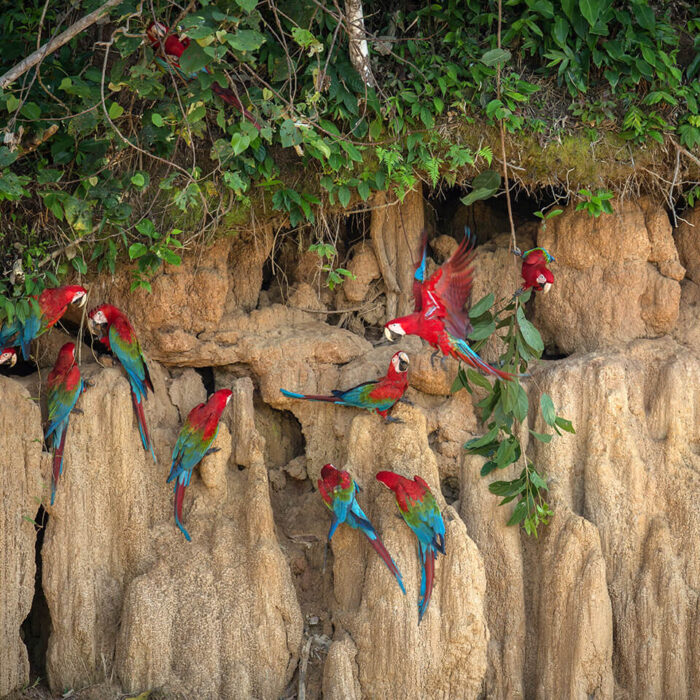
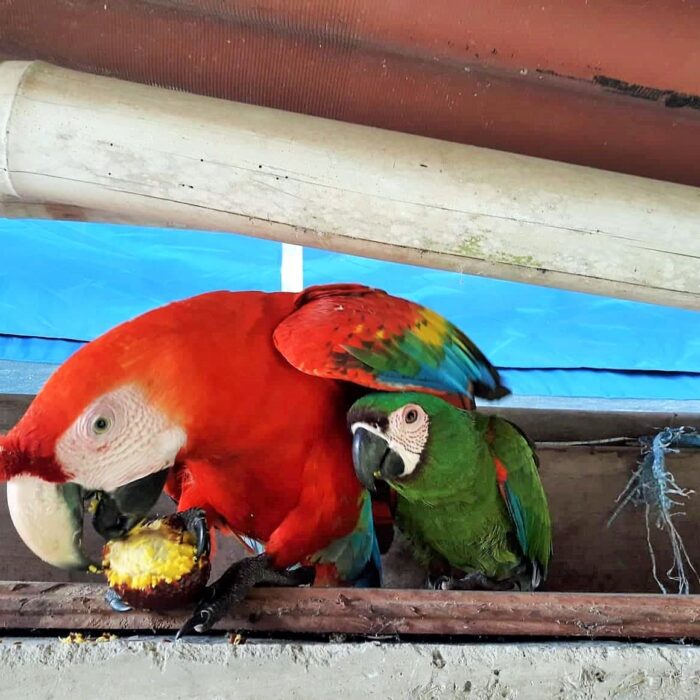
Collpas are natural clay deposits rich in mineral salts such as calcium, essential to the diet of many herbivorous animals. By consuming these clays, animals neutralize the toxins present in the plants they eat. Parrots, macaws, and parakeets often gather at riverbank cliffs to feed on these minerals, benefiting from open visibility to detect predators. Terrestrial mammals, such as tapirs and deer, visit inland collpas at night to perform the same behavior — known as geophagy.
COLLPA DE LOROS Y GUACAMAYOS
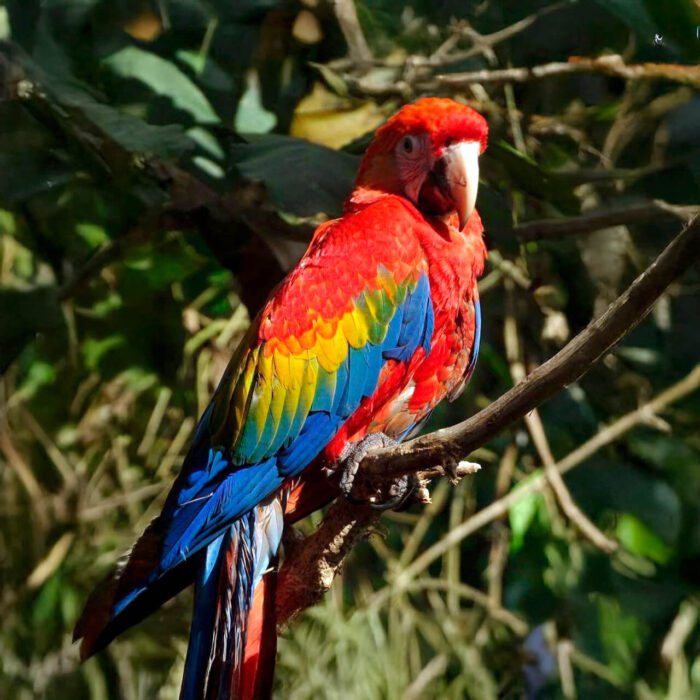
Early in the morning, thousands of parakeets and parrots — including majestic macaws — flock to the river cliffs for a feast of mineral-rich clay. This behavior helps them counteract the alkaloids from unripe fruits. The sight and sound of hundreds of colorful birds gathered on a single wall of clay is one of the most spectacular natural displays of the Amazon.
COLLPA DE MAMÍFEROS
Some collpas have been frequented by forest animals for centuries. Large muddy pools, carved bite by bite into the clay soil, bear the marks of countless visits from tapirs, peccaries, deer, and monkeys. These places remain essential to the health and survival of many mammal species in the Peruvian Amazon.